

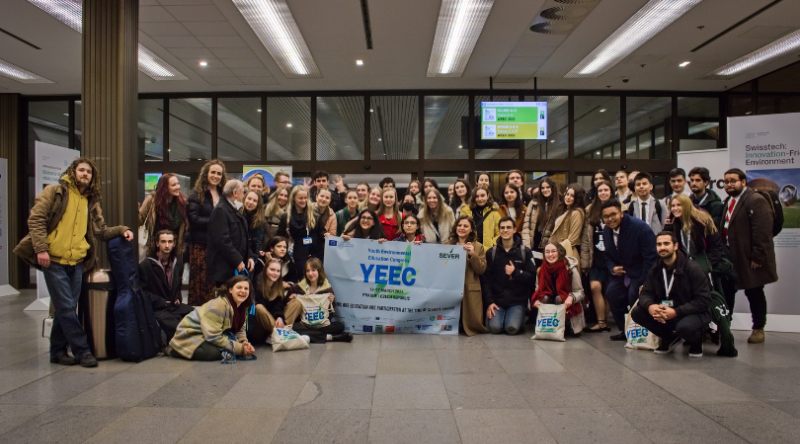
The message is a result of the meeting and common discussion of about 120 young people from 22 countries aged 14–26 years at the Youth Environmental Education Congress (YEEC) held on 13–17 March 2022 in Prague, Czech Republic, as a side event to the 11th World Environmental Education Congress (WEEC).
Before reading this message, please consider that the young participants had a very limited time to formulate their message, and it might be subject to editing in the near future. They delivered the message using different forms. For more details on how they themselves interpreted its content through their speeches, drama, poems, videos, comics, visual arts or open space, please visit this link.
We, the co-authors of the Youth Challenge Message, describe ourselves as young, critical (environmental) thinkers who
-
want to make the world a better place,
-
want to learn and educate at the same time,
-
care about others and cherish one another’s differences,
-
are part of the nature, and
-
are the change.
We started to get engaged in environmental movements (our “breakthrough moments”) being
-
inspired by the media, other active people, and access to scientific information, or
-
upset by people’s lack of appropriate response to environmental challenges, by the powerlessness of environmental education, by ecosystem destruction, and by an unfair distribution of resources.
We also share a vision of what the ideal alumni/graduates of education for sustainability should be like. They should:
-
feel safe to freely adopt and spread positive/constructive behaviour – take action to make that behavioural change possible,
-
link practical learning with theoretical learning,
-
listen to the people no matter how old they are, learning from one another, and
-
influence public discourse by leveraging different forms of media available to us in the 21st century.
1. An explanation given by one of the participants: Learning that there are more empty homes than homeless people; that 1/3 of the global food supply is wasted but 1 billion people are malnourished; that 40% of the global population experience severe seasonal water scarcity while water is plainly being wasted in some places; that the ultra-rich sit on golden toilets while 1 billion live below the poverty line.
We agree that we as young people can contribute to making education more sustainable and youth-engaging in the following ways:
-
inspiring others and motivating them to raise awareness – through videos, campaigns, environmental journalism, art, competitions, etc.,
-
educating others and influencing education in their schools – we can do informal education, form eco-clubs, organize open spaces, stimulate teachers to be mentors and rethink their role as teachers, and incorporate environmental education in all subjects,
-
being involved in youth administration and political activities such as youth parliaments and offices, we can have the power for change through policy influence,
-
making proposals on funding and accessibility of youth programmes – offering ideas on how to structure the funding more towards young people’s needs,
-
implementing community education, and
-
undertaking environmental internships.
We have also identified the obstacles faced by young people trying to be active in environmental education:
-
the apparently overwhelming need for a system change,
-
the time investment needed – to learn how to use one’s own time – while at the same time feeling that time is being taken away from us,
-
adults’ indifference to environmental challenges and the needs of future generations,
-
being afraid to be different and of being bullied as a result,
-
bad influence of adults and peers; feeling like a minority, and
-
lack of guidance by and opportunities from authorities.
2. An explanation given by one of the participants: when we start to realise that the problems we face are not just CO2 or species extinction but a cascading set of reinforcing destructive cultural feedback loops, we feel overwhelmed and have a hard time seeing how such a machine can be changed at all.
3. An explanation given by one of the participants: such as parents or teachers discouraging us from caring and taking action, making us feel unappreciated; seeing a celebrity popularising a wasteful lifestyle making us feel like a minority; our peers focusing on superficial topics making us feel irrelevant.
Based on these starting points and experiences, we have agreed the following CHALLENGE - KEY PROPOSALS, which were presented on 16 March 2022 to participants of the 11th WEEC and to representatives of UN agencies, European Union bodies, and Czech government ministries:
1) ENVIRONMENTAL EDUCATION MUST BE IN TEACHERS’ CURRICULUM so they can teach it; environmental education must be prioritised.
2) REAL-LIFE APPROACHES TO EDUCATION – education must be based on experiential learning and a non-academic, hands-on approach, focusing on developing strategic thinking.
3) INTERCONNECTION AND INTERDISCIPLINARITY AS THE KEY PRINCIPLE OF CURRICULUM – education must be interdisciplinary and based on a mixture of students’ cultural backgrounds; environmental needs should be covered throughout all subjects in a school curriculum.
4) INCLUDE YOUNG PEOPLE IN THE DECISION MAKING ON THEIR LEARNING – learning environments must be co-created by young people and others.
5) ACCESSIBILITY OF ENVIRONMENTAL EDUCATION TO ALL – environmental education must be inclusive (e.g. covering both urban and rural areas, public schools), it must offer a meaningful perspective; an adequate budget must be provided while spending money in an effective way.
Further proposals were raised at a follow-up meeting with decision-makers on 17 March 2022:
-
PARTICIPATION IN FORMING ENVIRONMENTAL EDUCATION POLICY: Ministries should start to include youth in the working groups on environmental education.
-
INNOVATIVE CURRICULUM RESPONDING TO ENVIRONMENTAL CHALLENGES: NGOs should be invited to co-work on defining the school curriculum.
-
SUPPORTING SCHOOL PRINCIPALS IN IMPLEMENTING ENVIRONMENTAL EDUCATION: Principals must be on board in environmental education.
-
TEACHER TRAINING AND SUPPORT IN ENVIRONMENTAL EDUCATION: Environmental education needs to be part of teacher education – in the context of universities and in-service training. Teachers also need support on how to implement environmental education in practice.
-
RECONSIDERING THE TEACHER’S ROLE: The role of teachers should be reconsidered more towards coaching/mentoring; there should be enough space for connecting teachers with students; and teachers should be able to say to their students, “I do not know, teach me”.
-
SAFE ENVIRONMENT FOR EDUCATION: Young people need a safe environment at schools and safe platforms to be able to meet like-minded peers.
-
LEARNING THROUGH REFLECTION, MISTAKES AS OPPORTUNITY TO LEARN: Young people need formative education and room for making mistakes, reflecting them and learning from them.